Incline bench press 1RM calculator + strength standards
At 180 lb bodyweight, a 180 lb incline bench press is intermediate and 250 lb is advanced. The incline barbell bench press tilts the torso to 30–45°, shifting the emphasis onto the clavicular (upper) head of the pec major and increasing the anterior deltoid's share of the work. That steeper angle lengthens the shoulder's moment arm and puts the press in a mechanically weaker position, so both the load and the tolerance for grinding a max are lower than on the flat bench: a strong case for estimating rather than testing. Note that the standards below are not measured independently: they are derived from the flat bench press figures scaled by the commonly reported ~0.8 ratio (incline 1RM is typically 70–85% of flat bench), so treat them as an indicative reference. As always, retract the shoulder blades and control the bar to the upper chest to protect the shoulder.
Incline bench press strength standards
Men
| Bodyweight | Beginner | Novice | Intermediate | Advanced | Elite |
|---|---|---|---|---|---|
| 140 lb | 55 lb | 85 lb | 140 lb | 195 lb | 225 lb |
| 160 lb | 65 lb | 95 lb | 160 lb | 225 lb | 255 lb |
| 180 lb | 70 lb | 110 lb | 180 lb | 250 lb | 290 lb |
| 200 lb | 80 lb | 120 lb | 200 lb | 280 lb | 320 lb |
| 220 lb | 90 lb | 130 lb | 220 lb | 310 lb | 350 lb |
| 240 lb | 95 lb | 145 lb | 240 lb | 335 lb | 385 lb |
Women
| Bodyweight | Beginner | Novice | Intermediate | Advanced | Elite |
|---|---|---|---|---|---|
| 110 lb | 20 lb | 45 lb | 65 lb | 90 lb | 110 lb |
| 125 lb | 25 lb | 50 lb | 75 lb | 100 lb | 125 lb |
| 135 lb | 25 lb | 55 lb | 80 lb | 110 lb | 135 lb |
| 155 lb | 30 lb | 60 lb | 95 lb | 125 lb | 155 lb |
| 175 lb | 35 lb | 70 lb | 105 lb | 140 lb | 175 lb |
Indicative standards based on recognised strength benchmarks (Symmetric Strength / ExRx), for an adult lifter. All values in pounds (lb).
Percentage-of-1RM table
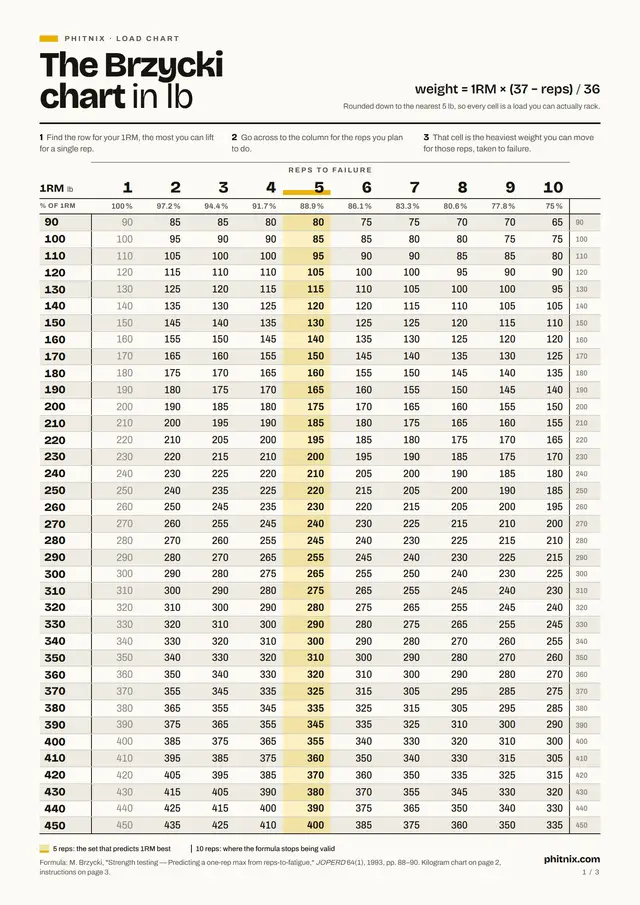
Once your 1RM is estimated, multiply it by the percentage on each row to get the working load matching your goal (strength, hypertrophy or endurance).
| % of 1RM | Load (e.g. 1RM = 200 lb) | Use |
|---|---|---|
| 100 % | 200 lb | 1 rep: maximal strength test |
| 95 % | 190 lb | 2 reps: pure strength |
| 90 % | 180 lb | 3-4 reps: strength |
| 85 % | 170 lb | 5-6 reps: strength / heavy hypertrophy |
| 80 % | 160 lb | 6-8 reps: hypertrophy |
| 75 % | 150 lb | 8-10 reps: hypertrophy |
| 70 % | 140 lb | 10-12 reps: hypertrophy / volume |
| 65 % | 130 lb | 12-15 reps: strength endurance |
| 60 % | 120 lb | 15+ reps: muscular endurance |
The "Load" column uses a 1RM of 200 lb as an example: multiply your own 1RM by the percentage to read your real working loads (it works the same in kg).
Incline bench press FAQ
What is a good 1RM incline bench press for a 180 lb man?
For a 180 lb man, expect around 70 lb as a beginner, 180 lb at intermediate level (1.0× bodyweight) and 250 lb for the advanced level (1.4×). The elite threshold sits near 290 lb (1.6×). These are a little below the flat bench figures, which is normal. In kilos, for an 80 kg man: 32, 80, 112 and 128 kg.
How much less should I incline press than I flat bench?
Plan on roughly 70–85% of your flat bench, i.e. about 15–30% lighter. If you flat bench 100 kg, an incline around 75–85 kg is typical. A wider gap usually means weak upper chest or front delts; a very small gap often means your bench angle is shallow or your flat bench is under-developed.
What are the most common incline bench form mistakes?
The usual culprits are setting the bench too steep (past 45°, which turns it into an overhead press and strains the shoulder), touching the bar too low on the belly to fake leverage, flaring the elbows wide, and losing the arch and scapular set that a flat bench relies on. Each shortens the effective range or overloads the shoulder while inflating the number.
Should you incline to 30 or 45 degrees?
The steeper the angle, the more the shoulder works and the lower the load. At 30° the upper-chest emphasis is already clear while keeping good strength; beyond 45° the movement gets close to an overhead press. Measure your 1RM at the angle you actually train.
Other exercises
← Back to the main 1RM calculator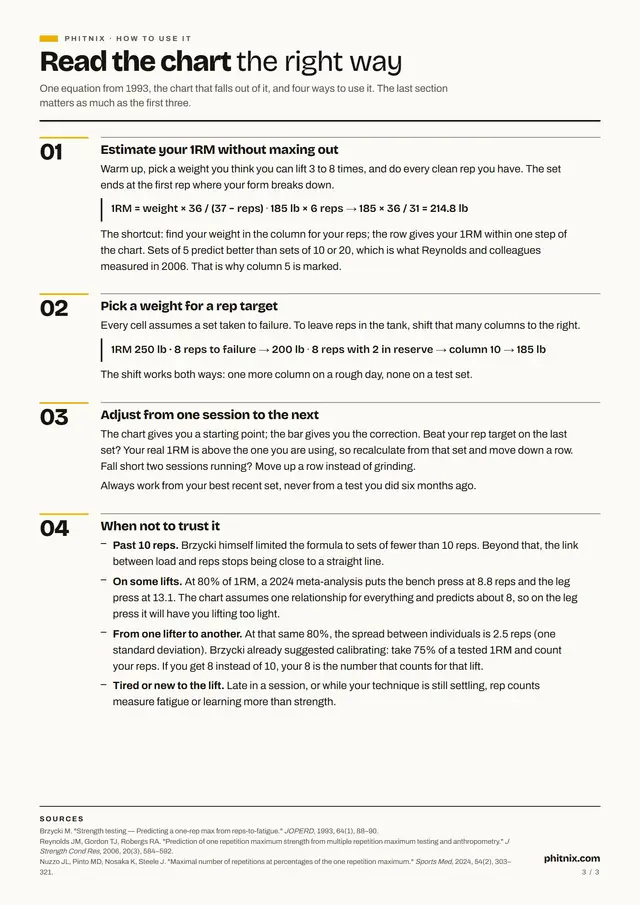
Free PDF · printable A4
Every working set, already calculated.
You get a minute or two between sets. No time for a calculator, and a load picked by feel means a missed set or a wasted one.
- 700 loads in pounds (90–450 lb) and kilograms (40–200 kg), 1 to 10 reps, rounded down to what you can actually load on a bar.
- The 5-rep column highlighted: the one that predicts your 1RM best.
- A one-page guide to the cases where the chart has you lifting too light (leg press, sets past 10 reps).
Turn these numbers into real progress
On Phitnix, a coach builds your cycles from your real loads and the workout log tracks your incline bench press 1RM over time. You know exactly when to add weight, without guessing.
Free · 7-day premium trial · no credit card