Bench press 1RM calculator + strength standards
Benching 225 lb at 180 lb bodyweight puts you at intermediate; 315 lb is advanced. The flat barbell bench press is the benchmark test of horizontal pressing strength, driven by the sternal head of the pec major, the triceps and the anterior deltoid. Because it is a supine press with a fixed bar path, the sticking point sits a few centimetres off the chest where the pecs lose leverage before the triceps take over at lockout, which is exactly why grinding a true single is so risky. Estimating your 1RM from a submaximal set spares your shoulders and pecs a maximal attempt while still anchoring your training percentages. On this lift more than any other, never test heavy without a spotter or safety pins: a failed rep pinned under the bar on your chest is the leading cause of bench press injury. Set a tight arch, pin your shoulder blades down and back, and drive through planted feet.
Bench press strength standards
Men
| Bodyweight | Beginner | Novice | Intermediate | Advanced | Elite |
|---|---|---|---|---|---|
| 140 lb | 70 lb | 105 lb | 175 lb | 245 lb | 280 lb |
| 160 lb | 80 lb | 120 lb | 200 lb | 280 lb | 320 lb |
| 180 lb | 90 lb | 135 lb | 225 lb | 315 lb | 360 lb |
| 200 lb | 100 lb | 150 lb | 250 lb | 350 lb | 400 lb |
| 220 lb | 110 lb | 165 lb | 275 lb | 385 lb | 440 lb |
| 240 lb | 120 lb | 180 lb | 300 lb | 420 lb | 480 lb |
Women
| Bodyweight | Beginner | Novice | Intermediate | Advanced | Elite |
|---|---|---|---|---|---|
| 110 lb | 30 lb | 55 lb | 85 lb | 110 lb | 140 lb |
| 125 lb | 30 lb | 65 lb | 95 lb | 125 lb | 155 lb |
| 135 lb | 35 lb | 70 lb | 100 lb | 135 lb | 170 lb |
| 155 lb | 40 lb | 80 lb | 115 lb | 155 lb | 195 lb |
| 175 lb | 45 lb | 90 lb | 130 lb | 175 lb | 220 lb |
Indicative standards based on recognised strength benchmarks (Symmetric Strength / ExRx), for an adult lifter. All values in pounds (lb).
Percentage-of-1RM table
Once your 1RM is estimated, multiply it by the percentage on each row to get the working load matching your goal (strength, hypertrophy or endurance).
| % of 1RM | Load (e.g. 1RM = 200 lb) | Use |
|---|---|---|
| 100 % | 200 lb | 1 rep: maximal strength test |
| 95 % | 190 lb | 2 reps: pure strength |
| 90 % | 180 lb | 3-4 reps: strength |
| 85 % | 170 lb | 5-6 reps: strength / heavy hypertrophy |
| 80 % | 160 lb | 6-8 reps: hypertrophy |
| 75 % | 150 lb | 8-10 reps: hypertrophy |
| 70 % | 140 lb | 10-12 reps: hypertrophy / volume |
| 65 % | 130 lb | 12-15 reps: strength endurance |
| 60 % | 120 lb | 15+ reps: muscular endurance |
The "Load" column uses a 1RM of 200 lb as an example: multiply your own 1RM by the percentage to read your real working loads (it works the same in kg).
Bench press FAQ
What is a good 1RM bench press for a 180 lb man?
For a 180 lb man, expect around 90 lb as a beginner, 225 lb at intermediate level (a 1.25× bodyweight ratio) and 315 lb to reach the advanced level (1.75× bodyweight). The elite threshold sits near 360 lb, roughly twice bodyweight. In kilos, for an 80 kg man: 40, 100, 140 and 160 kg.
How does my bench press compare to my squat and deadlift?
The bench is the lightest of the "big three": a typical trained lifter benches roughly 0.75× their squat and about 0.6× their deadlift. So if you squat 140 kg and deadlift 180 kg, a bench around 100–110 kg is well balanced. A bench that outpaces your squat usually signals under-trained legs, not an unusually strong chest.
What are the most common bench press form mistakes?
The big three are flaring the elbows to 90° (which stresses the shoulder joint; keep them tucked around 45–75°), bouncing the bar off the chest to cheat the sticking point, and letting the hips lift off the bench. Losing your upper-back tightness mid-set also collapses the arch and shortens your effective pressing power. Any of these inflates your estimated 1RM while raising injury risk.
Does the incline bench press count in these standards?
No, these standards apply to the classic flat bench press. The incline press recruits more of the upper chest and the shoulder: your 1RM there is typically 10 to 20% lower. Use the calculator on the exercise you actually test.
Why estimate your 1RM instead of testing it directly?
A true maximal bench press test fatigues the nervous system and exposes the shoulders to the risk of failing under the bar. Estimating from a set of 3 to 5 reps gives a result accurate to within a few percent, without that risk.
Other exercises
← Back to the main 1RM calculator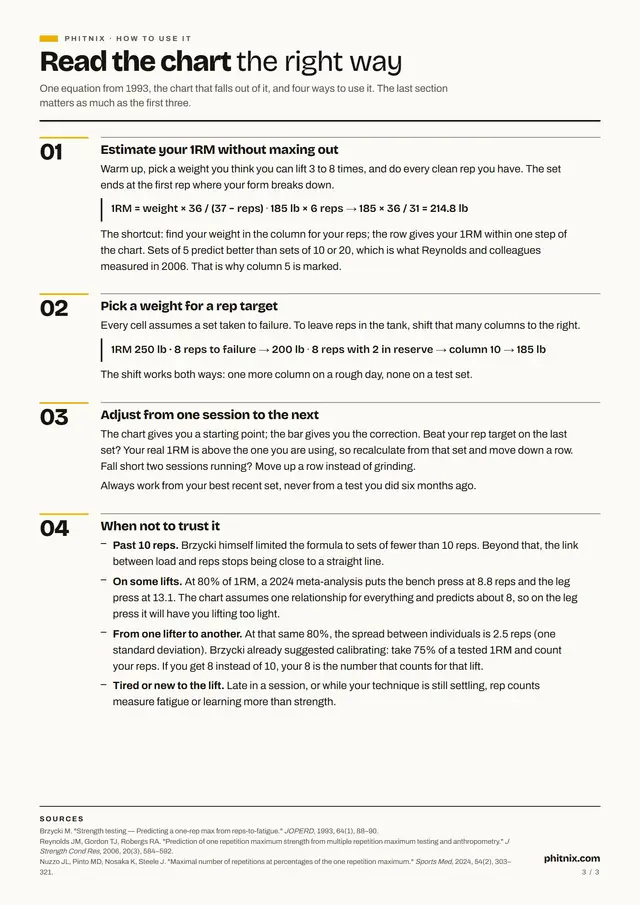
Free PDF · printable A4
Every working set, already calculated.
You get a minute or two between sets. No time for a calculator, and a load picked by feel means a missed set or a wasted one.
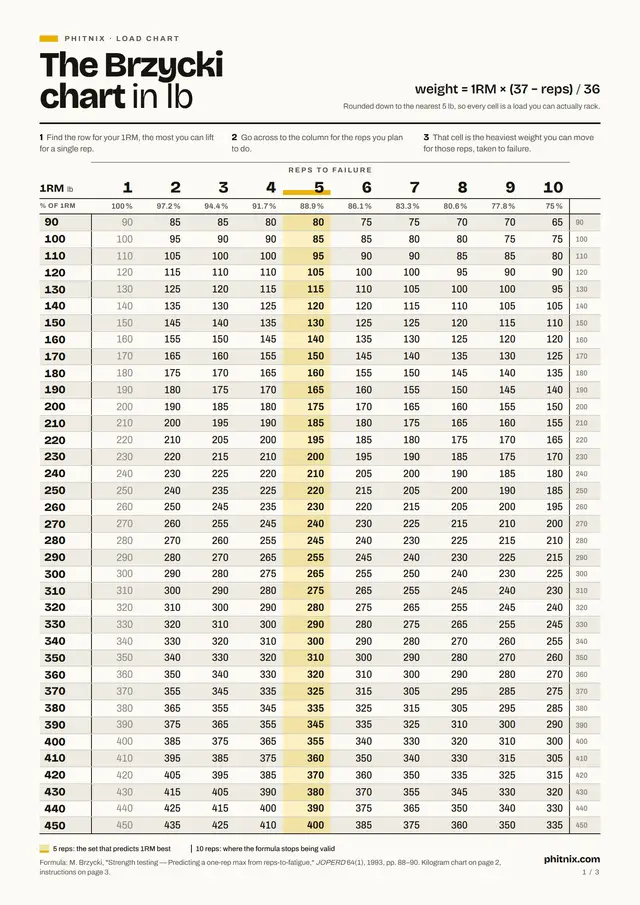
- 700 loads in pounds (90–450 lb) and kilograms (40–200 kg), 1 to 10 reps, rounded down to what you can actually load on a bar.
- The 5-rep column highlighted: the one that predicts your 1RM best.
- A one-page guide to the cases where the chart has you lifting too light (leg press, sets past 10 reps).
Turn these numbers into real progress
On Phitnix, a coach builds your cycles from your real loads and the workout log tracks your bench press 1RM over time. You know exactly when to add weight, without guessing.
Free · 7-day premium trial · no credit card